


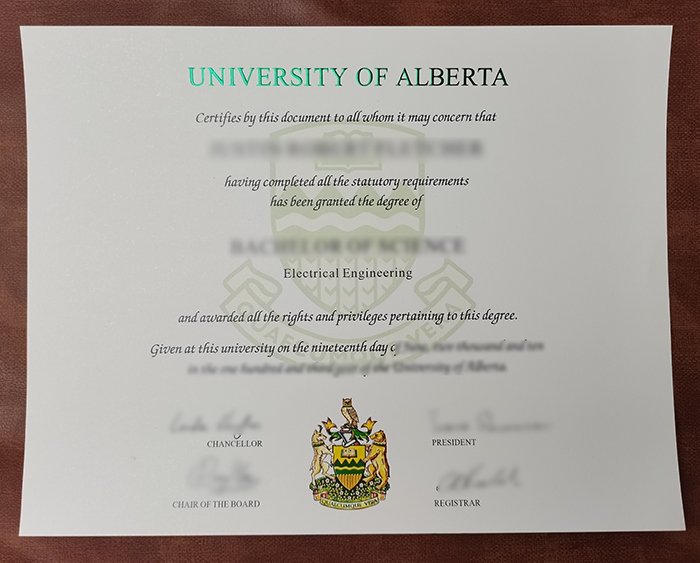
Located in the heart of North America’s energy heartland, the University of Alberta diploma presents a unique duality—rooted in one of Canada’s most economically dynamic provinces, yet maintaining a forward-looking perspective in dialogue with the world. Founded in 1908, this university defines itself by its province’s name, yet has never been confined by its geographical boundaries. The value of its diploma lies precisely in this creative fusion of global thinking and local practice. Buy fake University of Alberta diploma, buy fake University of Alberta degree, buy fake University of Alberta transcript.
The University of Alberta’s origins are closely linked to the development of Western Canada, with its initial agricultural and mineral resource research directly serving the regional economy. Today, this pragmatic approach has evolved into globally leading research in energy systems. Engineering students participate in experiments at the multi-million dollar “Future Energy Systems” research center, while arts and sciences students consider multiple pathways to energy transition through environmental and social courses. This interdisciplinary learning, built around complex real-world problems, enables diploma holders not only to understand technical details but also to grasp the interaction between technology and society, the economy, and the environment—a systems thinking ability particularly valuable in the era of energy transition.
If energy research represents a university’s “hard power,” then its achievements in health and life sciences showcase a unique “warm concern.” The University of Alberta’s medical school consistently ranks among the top in Canada, and its Diabetes Institute and Cardiovascular Research Centre are internationally renowned. Even more unique is the university’s integration of this research strength with specialized areas such as polar medicine and rural healthcare, addressing the unique health challenges of high-latitude regions. Nursing students learn culturally sensitive nursing practices in simulated Indigenous community settings, while public health research directly serves remote communities in the north. This educational philosophy, combining cutting-edge science with humanistic care, cultivates professionals who are both technically proficient and deeply empathetic.
The University of Alberta’s main campus is situated on the banks of the North Saskatchewan River, a microcosm of diversity itself—combining modern Brutalist architecture with traditional Gothic college buildings; it is both part of the city’s green space system and an independent academic community. This diversity is also reflected in its academic structure: the university comprises 18 faculties, including the Faculty of Indigenous Studies, offering over 200 undergraduate programs. Of particular note is its Undergraduate Research Program, which allows undergraduates to enter laboratories and research projects early on. This research-intensive undergraduate education is quite distinctive among Canadian public universities, enabling students to transform from knowledge consumers to creators before graduation.
As Alberta’s most important public research university, its diplomas carry a strong sense of public responsibility. This is reflected in the relative accessibility of tuition fees (compared to many prestigious British and American universities), and even more so in the promotion of “open educational resources”—the university is an active provider of numerous Massive Open Online Courses (MOOCs). Simultaneously, through its “Community Service Learning” program, the university directly connects over 300 courses with community needs. This dual commitment to openness and service ensures that education extends beyond the classroom, integrating into broader social dialogue and action.
While the diplomas from the University of Alberta may appear similar to those from other prestigious universities in terms of materials, their true value lies in representing a comprehensive capability formed within a specific geographical and cultural context: thinking about sustainable development in resource-rich regions, practicing inclusive innovation in diverse communities, maintaining an interdisciplinary perspective in an era of specialization, and deepening local participation in a globalized context. When graduates take this diploma to the world, they not only possess solid professional knowledge, but also a “bridging mindset”—the ability to connect and find balance between energy and the environment, technology and ethics, and global trends and local realities. In this increasingly complex and contradictory era, this ability may be more important than any single skill.