


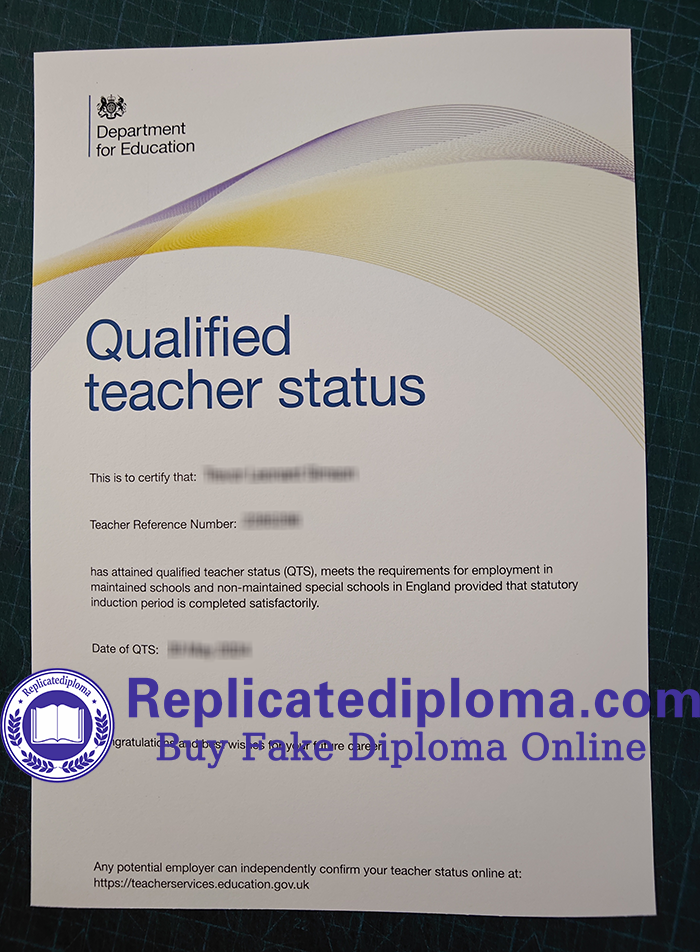
Buy fake Department for Education certificate, buy fake DfE certificate. In the UK education system, certificates issued by the Department for Education (DfE) represent a rigorous set of national standards and a commitment to quality. As the policymaker and regulator of education in England, the DfE, through its accreditation system, not only standardizes various qualifications from early childhood education to vocational training, but also substantially shapes the international reputation and internal consistency of British education.
The core value of DfE certificates lies first and foremost in their legal authority. As one of the core departments of the UK government, the DfE is directly responsible for education policy, school standards, teacher training, and child services in England. Certificates it issues or authorizes—whether the Quality Test for Teachers (QTS), the National Vocational Qualification (NVQ), or certifications for early childhood educators—represent that the qualification has met the minimum legal standards and is legally valid within the English education system. This gives certificate holders a unified professional qualification nationwide, forming a fundamental guarantee of education quality.
DfE certificates are the embodiment of the UK’s unique education quality framework. Taking teacher certification as an example, obtaining a DfE-recognized QTS certificate signifies that a teacher has not only completed training in subject knowledge and teaching methods but also meets the comprehensive requirements of the Teacher Standards regarding professional ethics, teaching effectiveness, and student development. This certification system, based on clear standards, makes the assessment of educators’ capabilities more systematic and transparent, and provides a reliable basis for schools’ hiring decisions.
It is noteworthy that the DfE certification system is constantly being dynamically adjusted, directly reflecting the strategic direction of national education policies. In recent years, to strengthen core subjects and professional skills, DfE has added specialized assessments for teacher certification in subjects such as mathematics, English, and STEM; and to improve the quality of early childhood education, it has updated the qualification framework for early childhood education practitioners. Each adjustment to the certificate requirements is essentially a concrete implementation of national education priorities at the individual qualification level, ensuring that educators are in sync with national strategies.
Internationally, the DfE certificate, leveraging the global influence of British education, is often regarded as a benchmark for high quality. Many Commonwealth countries and international schools give priority to recognizing teachers holding DfE certification, making this certificate a valid credential for cross-border educational career development. This international credibility stems from the historical foundation of British education and benefits even more from the rigorous standards maintained by the Department for Education (DfE) through continuous oversight.
Furthermore, the DfE certification system is closely integrated with the UK’s Continuing Professional Development (CPD) culture. Many certificates are not the end goal but are embedded in advancement paths across all educational stages, from entry-level to expert. For example, the advancement of teachers from early professional frameworks to senior leadership qualifications often uses obtaining different levels of DfE-recognized certificates as milestones, reflecting the lifelong learning ecosystem of British educators.
In conclusion, the UK Department for Education’s certifications are far more than just administrative documents; they are a crucial mechanism connecting national policy with educational practice, unifying domestic standards with international recognition, regulating professional entry, and supporting professional development. It acts as both a gatekeeper of educational quality and a transmitter of educational change, continuously playing a key role in setting benchmarks and anchoring values within the British and global education landscape.