


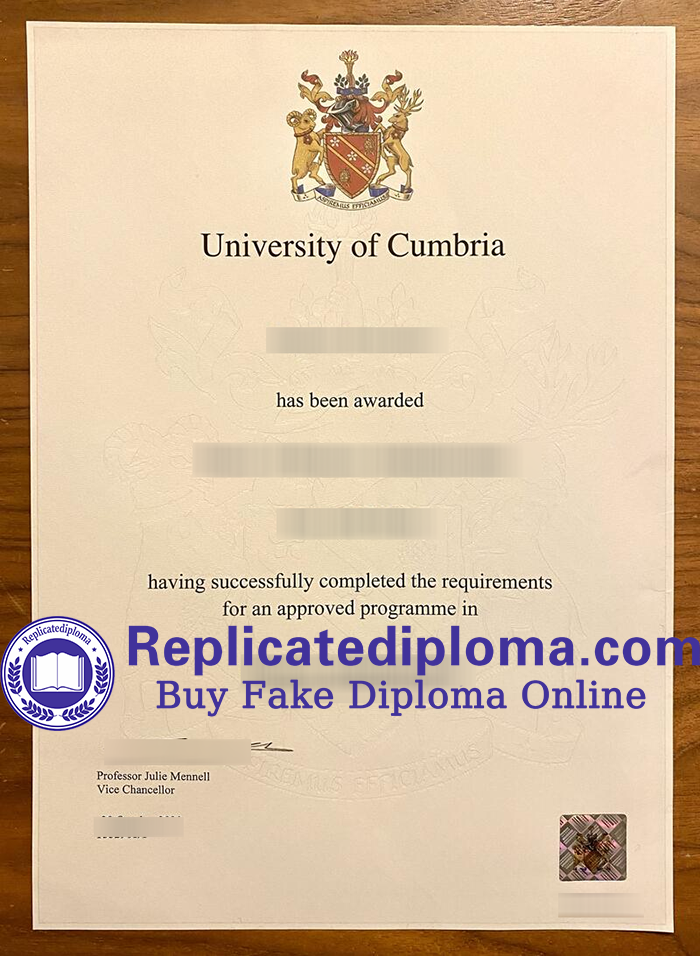
Buy fake University of Cumbria degree, buy fake University of Cumbria diploma, buy fake University of Cumbria transcript. Born in the heart of England’s most magnificent national park, the University of Cumbria’s degree is not a printed document, but a topographical specimen. The certificate paper incorporates fine siliceous rock powder unique to the Lake District, producing a slightly rough, slate-like feel when rubbed between the fingers—the very skeleton of Skofell, England’s highest peak. The paper edges retain irregular, rough edges, as if soaked and dried by the tides of Lake Windermere. Buy fake University of Cumbria diploma, buy fake University of Cumbria degree.
The university emblem at the top of the certificate is crafted using an ancient intaglio etching technique. You can feel the undulations of three mountain peaks: the highest point represents the purity of scholarship, the gentle slope on the left the applicability of profession, and the ridge on the right the integration into the community. This is not decoration, but the university’s survival geometry—in the sparsely populated Lake District, knowledge must simultaneously fulfill the functions of these three altitudes. Below the emblem, the Latin phrase “Altiora Peto” (I seek higher places), each letter’s shadow points at a different angle, suggesting that “altitude” has multiple definitions here.
At the heart of the University of Cumbria degree certificate is an invisible map of the lake region. Facing the northern light, the parchment reveals a watermark: fine contour lines spread like tree rings, the center not the university logo, but the outline of Lake Derwent. This isn’t nostalgia, but the topological structure of an educational philosophy—here, the classroom has no clear boundaries. Environmental science students measure water temperature changes in the heart of the lake, creative writing students search for Wordsworth’s rhymes on the stone walls of Pigeon Farm, and outdoor education students learn risk management on the scree slopes of Helvérin Peak. Their notebooks are often stained with soil samples from different altitudes.
The most unique feature of the University of Cumbria degree certificate is the wax seal in the lower right corner. It’s not the university’s coat of arms, but a simplified version of a “mountain weather symbol”: three wavy lines represent lakes, a triangle above them represents a mountain peak, and an arrow on the right indicates the ever-changing wind direction. This symbol is designed by students in the university’s design and crafts program, and every ten years a new generation of students reinterprets and fires a new wax seal. The seal, pressed onto parchment, leaves a three-dimensional imprint resembling fault lines in rock strata, symbolizing that knowledge here is a process of simultaneous deposition and fission.
On the back of the certificate, printed in ultraviolet ink, is an invisible manifesto—the core proposition of the university’s renowned sustainable leadership course: “The real resource is not the London Stock Exchange, but the water-holding capacity of the soil beneath your feet and the regenerative wisdom of your community.” This text only occasionally becomes visible under the ever-changing natural light of Cumbria.
Therefore, a degree from the University of Cumbria is essentially a “niche certification.” It doesn’t prove you’re a generalist in a particular field, but solemnly declares: what you learn here is how to find resilience in fragile ecosystems, the art of rebuilding connections in areas of population decline, and how to read the complex text of economic geography and collective memory within the landscape. When global cities are gripped by the anxiety of homogenization, this certificate offers a reverse scarcity—it proves that the holder understands how to build a self-sufficient system of meaning in places that don’t seek a “center.”
Those who hold this degree, whether walking into Manchester’s technology park or a London non-profit organization, possess a unique “climate intelligence” characteristic of the Lake District: a keen awareness of systemic vulnerabilities and the ability to sow the right seeds in the soil before rainfall arrives. In this era, this ability is perhaps more valuable than any single skill.