


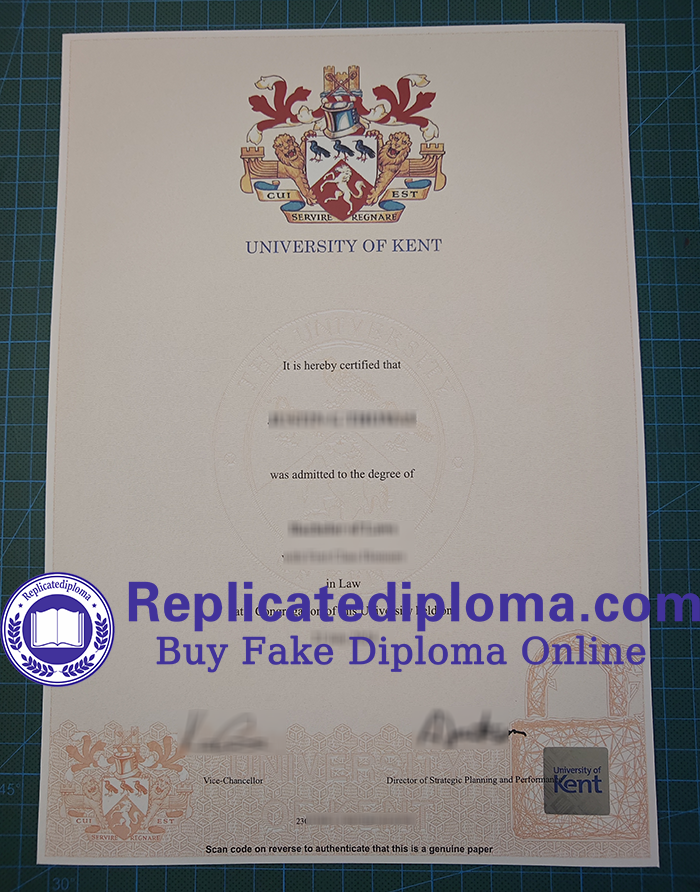
Buy fake University of Kent diploma, buy fake University of Kent degree, buy fake University of Kent transcript. How to buy University of Kent diploma? The thickness of a University of Kent diploma is equivalent to the thirty-four kilometers at the narrowest point of the English Channel.
When this certificate, made from a blend of local oak pulp and parchment, is unfolded, you touch the seam between two civilizations. At the top, the Latin motto in medieval Carolingian script forms a subtle symmetry with the rigorous modern English lettering below—this is not mere decoration, but a declaration of the university’s essence: founded in 1965, yet nestled within the Roman walls of Canterbury. Its “newness” must engage in a constant dialogue with its fourteen-hundred-year-old spiritual tradition.
The most unique value of the University of Kent diploma lies in its inherent “geographical dialectic.” The white horse on the coat of arms, facing the European continent, is not only the emblem of Kent, but also a cognitive stance. Every graduate who earns their degree here experiences this dual focus: a morning stroll along the starting point of Chaucer’s “Path of the Pilgrims,” and an afternoon analyzing the evolution of the EU legal framework in a seminar room. The seemingly irregular, rough edges of the diploma are a metaphor for this state of mind—knowledge here never ends in a perfect closed loop, but always remains open to the possibility of crossing the Channel.
For employers, this piece of paper is a guarantee of dual competence. The overlapping St. Augustine’s cross and the open book on the wax seal answer the underlying question: the holder of this diploma is deeply versed in the intricacies of the English common law system and also understands the logic of the civil law system; capable of cultivating a deep understanding of rigorous academic traditions while possessing a problem-solving awareness that transcends cultural contexts. When the City of London needs an analytical report that understands both the characteristics of the British market and anticipates the policy trends of Brussels, the holder of this diploma knows that the answer may not lie in any single model, but in the tides between the White Cliffs of Dover and the coast of Calais.
The watermarked map on the back of the University of Kent diploma, connecting the four campuses with major European cities with dotted lines, is not merely decorative. It suggests a networked ability to survive—propositions considered in Canterbury can be practiced in Brussels, revised in Paris, and deepened in Berlin. In this era of globalization, what’s most scarce is precisely this kind of “local globalist”: rooted in the soil of Kent, yet always able to adjust their focus to a broader chessboard.
It doesn’t promise you a position, but it grants you a precious “intermediary”—finding that dynamic fulcrum between the ancient and the modern, between Britain and Europe, between tradition and innovation. Holding this certificate, you don’t possess a key to a particular world, but rather a grammar for freely translating and navigating between multiple worlds. In this era of re-establishing boundaries, knowing how to build bridges is itself the rarest and most valuable asset.